
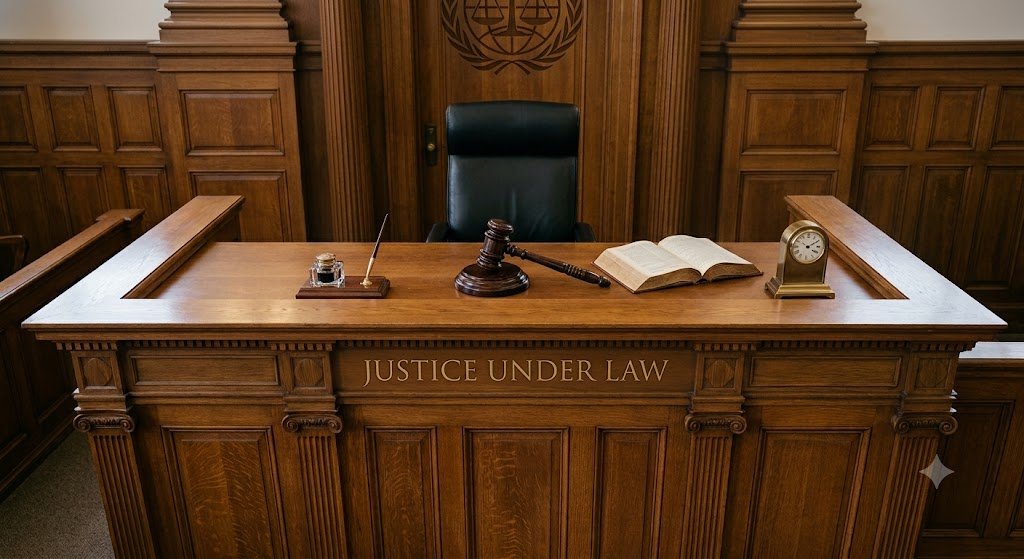
Case No. 017
The People v. “I Am On My Way.”
Court Clerk:
“All rise!”
“This Honourable Court is now in session. The Honourable Justice Common Sense presiding.”
Judge:
“Be seated.”
“Bailiff, why has the prosecution requested access to the records of Case No. 009?”
Bailiff:
“Because the People believe the accused may have returned to the same geographical offence, My Lord.”
The Judge looks towards the prosecution.
“Case No. 009?”
Prosecutor:
“The People v. ‘I’m Almost There,’ My Lord.”
The Judge leans back.
“I remember that case.”
“Google Maps.”
“One missing shoe.”
“And a defendant who was apparently travelling spiritually.”
The gallery laughs.
The Judge looks towards the accused.
“Do not tell me…”
The accused remains silent.
The Judge sighs.
“Proceed.”
Court Clerk:
“Case No. 017.”
“The People versus ‘I Am On My Way.'”
Charge: Premeditated Misrepresentation of Movement, Aggravated Geographical Ambiguity, False Implied Departure, and Repeated Abuse of the Phrase “I Am On My Way.”
Prosecutor:
“Ready for the People, My Lord.”
Counsel:
“Ready for the Defence.”
Judge:
“Bring in the accused.”
The accused enters the courtroom.
It is Mr. Everyman.
The Judge looks at him.
Then at the prosecution.
Then back at him.
“Mr. Everyman…”
“Yes, My Lord?”
“Did we not deal with your relationship with geography in Case No. 009?”
“My Lord, that was a different matter.”
The Judge raises an eyebrow.
“Was it?”
“Yes, My Lord.”
“In Case No. 009, you were ‘almost there.'”
“Yes, My Lord.”
“And now?”
“I am on my way.”
The Judge closes his eyes.
“Very well.”
“Let the record reflect that the Court has concerns.”
The Case for the Prosecution
Prosecutor:
“My Lord, the People submit that this case is the natural successor to Case No. 009.”
“In that case, the accused claimed to be almost there when he was nowhere near the destination.”
“Today, he has become more sophisticated.”
“He no longer claims to be close.”
“He claims to be moving.”
The Prosecutor pauses.
“The difficulty, My Lord…”
“…is that he was not.”
The gallery erupts.
Judge:
“Order!”
The Prosecutor continues.
“At 6:12 p.m., the accused sent a message.”
The Court Clerk displays the evidence.
6:12 p.m.
Other Party:
“Where are you?”
Mr. Everyman:
“I am on my way.”
The Judge nods.
“Continue.”
“At 6:13 p.m., the accused was at home.”
“At 6:17 p.m., the accused was still at home.”
“At 6:21 p.m., the accused remained at home.”
“At 6:28 p.m., the accused finally left.”
The Judge looks at Mr. Everyman.
“Sixteen minutes?”
“Yes, My Lord.”
“From your declaration of movement to actual movement?”
“Yes.”
The Judge looks towards the Prosecutor.
“That is ambitious.”
Exhibit A: The Case No. 009 Precedent
The Prosecutor places a file before the Bench.
“Your Lordship may recall the principle established in Case No. 009.”
The Judge nods.
“Actual proximity versus aspirational proximity.”
“Precisely, My Lord.”
The Prosecutor opens the file.
“In Case No. 009, this Court held that the accused could not claim to be almost there merely because he intended to become almost there.”
The Judge nods.
“And today?”
“Today, My Lord, the accused has simply moved the deception one stage backwards.”
The Judge leans forward.
“Explain.”
“In Case No. 009, he exaggerated his distance.”
“In Case No. 017, he has exaggerated his movement.”
The gallery murmurs.
The Judge smiles.
“That is rather clever.”
“Thank you, My Lord.”
“Do not compliment yourself in my courtroom.”
“My apologies, My Lord.”
Exhibit B: The Expanded Geography of “On My Way”
The Prosecutor approaches the screen.
“I am on my way.”
The phrase appears beneath several possible realities.
1.
“I have left.”
The Judge nods.
“Correct.”
2.
“I am walking to my car.”
“Still acceptable.”
3.
“I am putting on my shoes.”
The Judge pauses.
“Questionable.”
4.
“I am looking for my keys.”
The gallery laughs.
5.
“I am about to leave.”
The Judge shakes his head.
“Not quite.”
6.
“I have not moved from the house, but I thought I should reassure you.”
The gallery erupts.
Judge:
“Order!”
The Prosecutor turns towards the accused.
“Which definition applies to you?”
The accused pauses.
“Number five.”
The Judge looks at him.
“That is not what the phrase says.”
The accused says nothing.
The Prosecution Calls the Witness
Court Clerk:
“Call the witness.”
The People call Mr. GPS.
The witness enters the box.
The Judge looks at him.
“Mr. GPS.”
“My Lord.”
“You have appeared in matters before this Court?”
“Yes, My Lord.”
“Particularly matters involving people who believe they are closer than they actually are?”
“Frequently, My Lord.”
The gallery laughs.
Prosecutor:
“Mr. GPS, where was the accused when he sent the message?”
“At home.”
“Was he moving?”
“No.”
“Was he travelling?”
“No.”
“Was he on the route?”
“No.”
“Had he begun the journey?”
“No.”
The Prosecutor pauses.
“So, geographically speaking…”
He turns towards the accused.
“…where was he?”
“At the beginning.”
The gallery erupts.
The Judge bangs his gavel.
“Order!”
The Prosecutor nods.
“The People rest.”
The Defence
Counsel:
“My Lord, the prosecution is attempting to impose military-grade geographical precision on an ordinary conversational expression.”
The Judge looks at him.
“Military-grade?”
“Yes, My Lord.”
“My client was communicating intention.”
“He was saying that he was coming.”
“He was not submitting a live location.”
The Judge nods.
“Fair.”
Counsel continues.
“Human communication is flexible.”
“People say ‘I am on my way’ to reassure others that they have heard them and are making their way towards them.”
“That intention should not automatically be treated as deception.”
The Judge looks towards the Prosecutor.
“Reasonable.”
The Prosecutor rises.
“With permission, My Lord.”
“Proceed.”
“Would Counsel agree that intention and movement are two different things?”
“Yes.”
“And would Counsel agree that my client had not yet begun moving?”
“Yes.”
“Then what exactly was he on his way from?”
Counsel pauses.
“My Lord…”
The gallery laughs.
The Judge smiles.
“Counsel, that is a fair question.”
Cross-Examination
Prosecutor:
“Mr. Everyman, when you sent the message, had you left your house?”
“No.”
“Had you entered your vehicle?”
“No.”
“Had you started the engine?”
“No.”
“Had you found your keys?”
A pause.
“No.”
The gallery erupts.
Judge:
“Order!”
“Had you put on your shoes?”
“One of them.”
The gallery explodes.
The Judge bangs the gavel.
“Order!”
The Prosecutor looks at the accused.
“Mr. Everyman…”
“Yes?”
“When you said ‘I am on my way’…”
“Yes?”
“…you had one shoe on?”
“Yes.”
“And the other?”
“I was looking for it.”
The Judge slowly removes his glasses.
“We have returned to Case No. 009.”
The gallery erupts.
The Judgment
Justice Common Sense sits quietly.
He looks at the accused.
Then at the GPS report.
Then at the old Case No. 009 file.
Finally, he looks at the phrase on the screen.
I am on my way.
The Judge speaks.
“The Court has heard the evidence.”
“Case No. 009 established an important principle.”
“Actual proximity is not the same as aspirational proximity.”
“Today, the Court is asked to consider its close relative.”
“Actual movement is not the same as aspirational movement.”
The gallery becomes quiet.
“There is nothing wrong with telling someone you are coming.”
“There is nothing wrong with reassuring someone that you intend to leave.”
“There is nothing wrong with saying that you will be there soon when you genuinely expect to be.”
“But words must remain reasonably connected to reality.”
The Judge pauses.
“If you are still looking for your keys…”
“You are not yet on your way.”
“If you are still choosing what to wear…”
“You are not yet on your way.”
“If you are still in the shower…”
“You are definitely not on your way.”
The gallery erupts.
Judge:
“Order!”
“And if you have one shoe on…”
The Judge looks towards Mr. Everyman.
“…the Court will not accept your argument that you have commenced the journey.”
The gallery explodes.
The Judge continues.
“The Court therefore establishes a useful distinction.”
Preparing to go is preparation.
Planning to go is intention.
Leaving is movement.
Being on the way is travel.
“And these things should not be collapsed into one convenient sentence merely because someone is waiting.”
The Judge looks towards the accused.
“Case No. 009 taught you not to manufacture proximity.”
“Case No. 017 teaches you not to manufacture movement.”
The Judge pauses.
“The Court suspects there may be a Case No. 018 waiting somewhere in the future.”
The gallery laughs.
“Let us hope it concerns arrival.”
Verdict
The accused, “I Am On My Way,” is hereby found:
NOT GUILTY of being inherently deceptive.
NOT GUILTY of communicating intention.
NOT GUILTY of being used colloquially.
However…
GUILTY of premature deployment.
GUILTY of confusing preparation with movement.
And GUILTY of attempting to improve upon the geographical offences already documented in Case No. 009.
Sentence is hereby passed:
The phrase “I am on my way” shall henceforth require evidence of actual or genuinely imminent departure.
The following shall not constitute sufficient evidence:
One shoe.
Missing keys.
An open wardrobe.
A shower in progress.
A phone still charging.
“I am just about to leave.”
And certainly not…
“I have been meaning to leave.”
The Judge looks towards Mr. Everyman.
“If you have not left…”
“Say so.”
“If you are about to leave…”
“Say so.”
“If you have left…”
“Then you may say…”
He pauses.
“I am on my way.”
The Judge raises his gavel.
“Because unlike Case No. 009…”
“…this time, the Court wants the movement to be real.”
Bang.
The Principle of the Court
“Intention is not movement, just as intention was not proximity.”
“Case No. 009 taught us that wanting to be near someone does not make you almost there.”
“Case No. 017 teaches us that intending to leave does not mean you are already on your way.”
“Words do not need to be mathematically precise.”
“But they should have some relationship with reality.”
“And if someone is waiting for you…”
The Judge pauses.
“…do not send them the location of your future self.”
Court is adjourned.
Next Week Before This Honourable Court…
Case No. 018
The People v. “I Will Get Back to You.”
The prosecution alleges that the accused made a seemingly harmless promise to respond…
…and then disappeared into the wilderness of unfinished conversations.
The Defence maintains that “I will get back to you” is not a deadline.
The People intend to establish that the accused said it on Monday…
…was reminded on Wednesday…
…was reminded again on Friday…
…and finally responded three weeks later with:
“Sorry, just seeing this.”
The Court will determine whether “I will get back to you” constitutes a genuine commitment to return…
…or the conversational equivalent of placing something in a drawer and hoping nobody remembers where it is.
Proceedings continue next week.